
How to Reach Out to Affiliates and Actually Get Responses
- 7 mins
Getting creators to respond to affiliate outreach can be harder than it looks.
If your emails are being ignored, the problem isn’t necessarily the creators you’re contacting. In many cases, the issue is the pitch itself.
Affiliate partnerships work differently from traditional paid collaborations. With a sponsored campaign, a creator knows they’ll receive a fixed payment for producing content. With an affiliate partnership, their earnings depend on whether their audience actually purchases something.
That means you’re asking the creator to take on some of the risk.
So instead of simply asking someone to “partner with us,” your outreach needs to answer a more important question:
Why is this affiliate opportunity worth the creator’s time?
This guide breaks down how affiliate outreach differs from traditional influencer outreach, what a high-converting affiliate email should include, examples you can adapt, and how to scale your outreach without turning every message into a generic mass email.

Affiliate Outreach vs. Influencer Outreach: What's the Difference?
The basic distinction is straightforward.
Influencer outreach usually involves offering a creator a fixed fee in exchange for creating and publishing content.
Affiliate outreach asks the creator to promote a product and earn a percentage of the sales generated through their link or code.
That difference changes the entire sales pitch.

1. The creator takes on more risk
With a paid collaboration, the brand assumes most of the performance risk. The creator receives their agreed fee regardless of how many people click, buy, or engage.
Affiliate partnerships work differently.
If nobody purchases, the creator earns nothing.
Even hybrid arrangements, where a creator receives a smaller fixed payment plus commission, still involve a performance component. The creator is also giving up time that could have been spent on another guaranteed-fee partnership.
Your outreach therefore needs to communicate more than enthusiasm for the creator’s content. You need to make the potential upside clear enough that taking that risk feels reasonable.
2. Audience fit becomes critical
A creator can have excellent engagement and still be a poor affiliate partner.
Why? Because affiliate earnings depend on conversions.
If the creator’s audience isn’t interested in the product, even a highly engaged community may generate very few sales. Research cited by GoMarketish identifies audience mismatch as a major reason creator collaborations fail.

This is why affiliate outreach needs to demonstrate why the creator’s specific audience is likely to care about the product.
Simply saying “we love your content” isn’t enough.
The creator needs to see the connection between:
their audience → your product → potential purchases → their commission.
That also explains why the usual influencer-outreach formula doesn’t always translate directly to affiliate campaigns. Personalize the opener, introduce the brand, ask about a collaboration, and follow up several times may work reasonably well when there’s a guaranteed fee.
Affiliate recruitment requires more context because the creator has another question to answer:
“Will my audience actually buy this?”
How to Write an Affiliate Outreach Email
A strong affiliate email needs to do more than introduce your brand. Since creators only earn when they generate sales, your message should quickly explain why the partnership makes sense for them.
1. Write a Clear Subject Line
Avoid generic subjects like:
“Collab Opportunity With [Brand]“
Instead, make the offer specific:
• Thought of you for our affiliate program
• Earn [X]% with [Brand]
• Why your audience would love [Product]
• Partner with [Brand]?
The goal is to make the email feel relevant, not like a mass message.
2. Explain Why They’re a Good Fit
Don’t just say you love their content. Explain why their audience matches your product.
Weak:
“We love your content and would love to work with you.”
Better:
“Your audience is mainly first-time homeowners, which is exactly who our starter furniture sets are designed for.”
This shows you’ve actually researched the creator and gives them a reason to believe the partnership could generate sales.
3. Make the Commission Clear
Avoid vague phrases like “great commission.”
Tell creators exactly what they can earn:
• Commission rate
• Approximate earnings per sale
• Attribution period
• Payment schedule
For example:
“You’ll earn 15% per sale, tracked for 30 days and paid monthly.”
Clear numbers make the opportunity easier to evaluate.
4. Keep the CTA Simple
Don’t ask creators to schedule a call or complete a long application immediately.
Instead:
“Interested? Reply and I’ll send the product so you can try it first.”
A simple next step makes it easier for the creator to say yes.
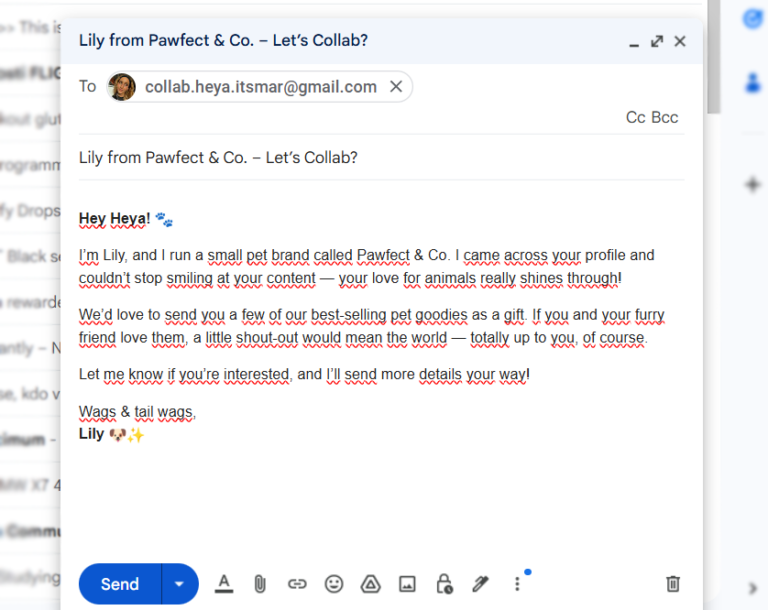
Affiliate Outreach Email Example
Affiliate Email
Subject: Thought of you for our affiliate program
Hey {{name}},
I’m [Name] from [Brand]. We make , and I think it would be a great fit for your audience because [specific reason].
We’re offering [X%] commission on every sale through your link, tracked for 30 days and paid monthly.
If you’re interested, just reply and I’ll send over so you can try it yourself.
Best,
[Your Name]
How to Follow Up
If you don’t receive a response, don’t give up after one email. Send 2–3 follow-ups, roughly a week apart. For creators you really want to work with, you can follow up again after a longer gap.
Follow-Up Email
Subject: Following up on our affiliate program
Hey {{name}},
Just wanted to follow up in case my last email got buried. If you’re interested, I’m happy to send more details or get you set up.
[Your Name]
How to Scale Outreach
You don’t need to write every email from scratch.
Template the information that stays the same, such as your brand and commission details, but personalize the section explaining why the creator’s audience is a good fit.
This lets you increase your outreach volume without making every email feel like a generic mass message.
What a Low Reply Rate Means
If creators aren’t responding, review your pitch before blaming your prospect list.
- Is the audience-product fit clear?
- Is the commission specific?
- Are the terms easy to understand?
- Is the CTA simple?
- Are you following up?
A strong affiliate pitch should make the opportunity clear, relevant, and easy to act on.

FAQs
Explain why the creator’s audience fits your product, provide clear
commission details, outline the basic terms, and finish with an easy CTA.
Yes. Give creators a clear idea of what they can earn rather than
using vague language.
Start with 2–3 follow-ups spaced about a week apart. For important
prospects, you can revisit them after longer intervals.
Start with existing creator partners, customers, and people already
talking about your brand. Then look for new creators based on
audience fit and content.
Not necessarily. Manual outreach works for small campaigns, but
tracking contacts, follow-ups, and results becomes harder as your
outreach grows.
We Make The Difference.
GoMarketish Team